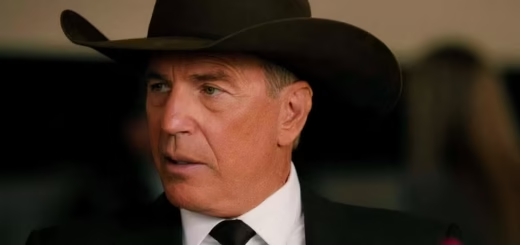
Kevin Costner’s LIVE TV Moment That Shocked Everyone — Control Slipped Away in Seconds!
There are interviews. There are debates.
And then there are moments on live television that feel completely different — raw, unscripted, and impossible to fully contain once they begin. What happened during Kevin Costner’s appearance on The View was not just another on-air exchange. It became something deeper — a reflection of control, power, and the unseen boundaries that shape public conversation.
At first, everything seemed ordinary.
Costner entered the studio calm and composed, as expected from someone who has spent decades in the public eye. Nothing about his arrival suggested tension. Nothing indicated that the conversation would take an unexpected turn.
But even the most structured environments can be fragile, because control only exists as long as predictability holds.
The shift began subtly.
There was no sudden outburst or obvious confrontation. Instead, the tone changed gradually — in pacing, in responses, in the direction the discussion started to take. For a tightly formatted show like The View, even a small deviation can shift the entire dynamic. Once a conversation drifts away from its intended path, it becomes something less controlled and more unpredictable.
Costner did not raise his voice. He did not dominate the exchange. In fact, he remained unusually steady.
That calmness itself changed the atmosphere.
Television conflict often escalates in a familiar pattern — stronger emotions, sharper interruptions, rising intensity. But when one participant refuses to match that escalation, it creates imbalance. It forces the entire room to adjust.
In that space, tension becomes more visible, not less.
His remarks were measured and direct, focusing less on winning an argument and more on questioning the structure of the discussion itself — the idea that public platforms, while appearing open, often operate within invisible limits.
Limits on speech. Limits on acceptable perspectives. Limits that are rarely spoken aloud but are still enforced.
That is where the moment became significant.
Rather than simply responding within the conversation, Costner reframed it. He shifted attention away from the topic and toward the format itself — suggesting that what looks like open dialogue may, in reality, be carefully controlled.
On live television, that kind of shift is difficult to manage.
When Joy Behar called for his microphone to be cut, it reflected more than disagreement. It signaled a loss of control over the direction of the segment — a recognition that the exchange had moved beyond its expected boundaries.
That moment made the underlying tension visible.
Costner did not escalate. He did not argue the decision. Instead, he acknowledged the situation and pushed past it.
“You can turn my microphone off… but you cannot silence my voice.”
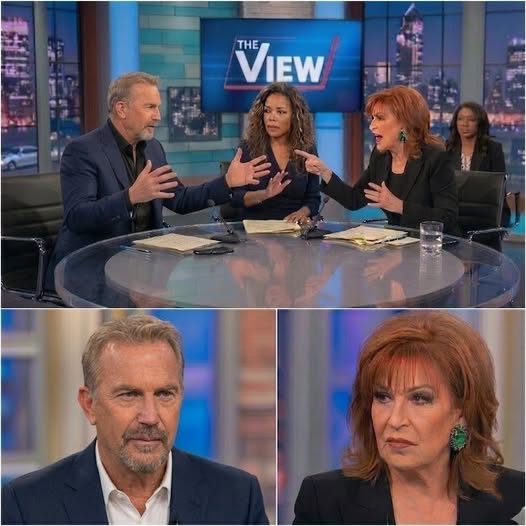
The impact of the statement came from its simplicity rather than drama. It was not only about the studio or the show — it pointed to a broader distinction between being allowed to speak and truly being heard.
In media environments, participation often comes with unspoken conditions: tone, timing, alignment with format, and adherence to structure. Most guests follow those rules without question, because stepping outside them carries consequences — loss of access, opportunity, or perception.
That is what makes moments like this rare. They require accepting those risks.
Costner’s exit was not loud or chaotic. There was no extended confrontation. No attempt to overpower the situation.
It was quiet. Deliberate. Final.
And that is what gave it weight.
It was not reactive — it was intentional. A decision to step away rather than continue within boundaries that no longer felt acceptable.
Afterward, clips spread quickly and reactions followed from all directions. Some focused on his composure, others questioned the approach, and many debated what the moment revealed about televised conversation in general.
But beneath the surface, a larger question remains:
What does it really mean to have a voice in a controlled space?
Is simply being present enough, or does presence only matter when speech is unrestricted?
That tension extends far beyond television. It exists in many environments — professional, social, and public — anywhere structure meets individuality.
And that is why the moment resonated.
Because it reflected something broader: systems designed for dialogue often still rely on boundaries that limit it.
When those boundaries are challenged, the reaction is rarely neutral. It tends to be defensive, structured, and immediate.
Even the silence after Costner’s departure felt meaningful. The segment did not transition smoothly. There was no instant recovery. Just an interruption in flow — a brief pause where the system had to recalibrate.
That silence, in its own way, said everything.
It suggested that something had happened that could not be easily absorbed.
In the end, it was not simply a tense television moment.
It was an illustration of how control works — and what happens when someone chooses to step outside of it.
Not loudly.
Not aggressively.
But clearly.
And sometimes, that kind of clarity is what disrupts everything most.